Wednesday, October 7, 2015

Factional Control and Its Solution

Lucas Rosen
Ms.Gordon Per.2
10/6/15
Separate Powers and Factional Control


Factional Control and Its Solution


The American Constitution is a renown document throughout the world. Without this important piece of history America would not be the country it is today. This constitution has faced many difficulties. None were more challenging that its conception, its ratification by the colonies. In 1787 the Constitutional Convention was held. This Convention was a gathering of the representatives from different colonies in order to create a stronger federal government. Through-out the Convention many problems and disagreements were faced and overcome, but none was a big as the ratification debate. Anti-Federalists challenged the Constitution by saying that the government would have too much power. After much arguing, both sides, Federalists and Anti-Federalists, reached a compromise creating a separation of power. The separation of power blocks factional control of the government by introducing a system of intricate checks and balances.
Originally the theory of the separation of powers comes from a french theorist by the name of Montesquieu. His theory says that “government could be controlled by dividing it among separate branches rather than investing it entirely in a single individual or institution” (Patterson, pg.38). Montesquieu's theory served as the basis for dividing our government into different branches, but the framers of the constitution did not feel this was adequate. They needed to improve upon it in order to prevent one branch from gaining too much control. So a system called checks and balances was created. This system placed limits on each branch of the government in order to evenly distribute power and create a co-dependency of the separate branches.
The system of checks and balances did not have all the Anti-Federalists convinced that a strong federal government was a safe practice. The Federalists realized that they needed to show the Anti-Federalists how necessary a strong but balanced federal government was. The strongest argument was put forward by three Federalists (James Madison, Alexander Hamilton, and John Jay) in a series of essays that have come to be known as The Federalist Papers. In Federalist Paper No. 10 James Madison turns the Anti-Federalists argument on its head. The paper was about how in the colonies’ republican governments the majority had a overwhelming power over the minority. He also expressed how the oppression of minorities was no better than being oppressed under a monarchy. This argument allowed Madison to demonstrate how in a strong federal government with checks and balances no one part of the government could gain control over other branches or purposely oppress the minority.
The Constitutional Convention sparked many great debates and created many great compromises. However, the Federalists were the winners of the Convention. Without that we would not have our constitution as it stands today. All the framers of the Constitution were able to create something neither side could have done on their own; a system of checks and balances for our branches of government. The theory of separation of powers has become a reality. This system has successfully blocked factional control and allowed diverse american voices to be heard.

Monday, October 5, 2015

Quinn Tucker
AP Government, Period 3
Ms. Gordon
October 1, 2015
Federalist Papers & Factional Control
            The constitutional convention was an extremely unique time. The founding fathers became the first in world history to create a new nation out of a revolution and create a place that’s priority was to create liberty. However, due to the history of the new nation and the diversity of perspectives creating a government that would be fair proved to be difficult.  The revolution made the American’s fear a powerful person or persons in power. However, the initial Articles of Confederation were too weak and left the states more a separate entities then a unified nation. As a result they were trying to create a government that wouldn’t end up with too much power falling into the hands of a specific interest group or political party but still had the power to unify the nation and have certain powers.
From the Philadelphia Convention came the Federalist Papers written by James Maddison and Alexander Hamilton. The goal of these papers was to convince the American public of the purpose of having a stronger federal government under the constitution. The papers explained the concept of balance of powers. That through breaking the government into three separate bodies they were allowing not too much power to fall into the hands of one person one group. This concept was inspired by a philosopher named Montesquieu who believed that through separate branches a government wouldn’t be corrupted. The reason this separation of power was successful was due to the fact that the fragmented structure of the government doesn’t allow for power to fall into the hands of one specific person or group of persons, otherwise known as factional control.
In “Federalist” No. 51 Madison discusses how the separation of national institutions was designed both to empower and restrict the national government. This is similar to Montesquieu and his idea of separate branches because of the separation no one side can gain absolute control. Madison continues by saying that no main government branch should be directly administered by another and none will have overruling influence over another. Through this balance in the branched and through the checks and balances we obtain a unification in our government. Madison also discusses how even though the legislative branch tends to gain superiority over the two other branches the presence of the three departments naturally limits against the “tyrannical concentration.” In addition, through the two sided Congress factional control is yet again blocked. The Senate is an even playing field for all states because no one large state can end up controlling the federal government as well. Whereas the House of Representatives is based on population so the majority populations can still have their voices be heard. This system prevents one party from simply gaining significant control of the government no matter their state size or value.  
The other concern was the fact that one branch would ultimately control the others. However this was solved through each department has a will of its own as a result it allows for the government to naturally not fall into the powers of one since on branch can’t control all roles of the government. This is a direct copy of Montesquieu’s philosophy. Even though a lot of power may fall into one branch at a time, the way government is structured allows for minorities to have representation. In “Federalist” No. 10 Madison discusses factions are a “dangerous vice” to government. He continues by discussing how the government shouldn’t be controlled by a faction group but should be controlled by liberty. The branches system allows for a separation that ultimately prevents faction leaders “kindle a flame” in one state, but wouldn’t be able to spread to another state or even the national government.

Through a blending of unique and new philosophies, the founding fathers were able to create this union that was empowered and weakened by its own existence. This truly unique system is surly flawed but has gone unchanged for hundreds of years. The factional concerns of Constitutional times are so similar to the issues we face today in the polarization of our current political scene. However, through history the elections by the American people often contrast their choices in terms of laws. For example, in the recent voting ballet Congress became extremely more Conservative. In contrast, people voted on laws and bills that were more liberal. The concern of a mob or majority government is very relevant, however it appears the American people sometimes naturally balance power out themselves. 

Ben Neumann

When the farmers of the constitution met, one of their main goals was to make sure that there was a system of separation of powers within our government so that no one faction could acquire all the power. In federalist number 10 Maddison discusses how there are only two ways to control factions and those were remove its causes and to control its effect. Since we cannot remove its causes without becoming communist we would have to control its effects. We did this by creating the system of checks and balances. This system of checks and balances is influenced by, Montesquieu, a french enlightenment thinker. He said that the government should be divided strictly on institutional lines, the farmers followed this theory but also implemented the system of checks and balances we see today. This new separation of government and creation of the checks and balances system, made it so each branch could override each other making it harder for one faction to have complete control. The executive branch headed by the President could veto a bill passed by Congress, the legislative branch can override the President with a two-thirds vote, and the Judicial branch can abolish a law if it is deemed unconstitutional. With this new system in place it makes it almost impossible for a single faction to gain control over the government. 


Without the influence of separation of powers and implementing checks and balances into the new constitution, the United States could have ended up with the same form of government they had just escaped. Because we implemented it we made a government that serves the people and is protected from factions by a system of separation of powers and checks and balances. 

Sunday, October 4, 2015

Factional Control and Separation of Powers - Kenneth Martin

Kenneth Martin
AP US Government & Politics Period 3
Mrs. Gordon
October 2, 2015
Why is the theory of separate powers a cure to blocking factional control?

In 1787, delegates from the thirteen states met in Philadelphia to revise the Articles of Confederation. Instead, they constructed an entirely new Constitution. This Constitution created a strong national government headed by three separate entities: the President, Congress, and the Supreme Court. The President was to have executive powers, Congress to have legislative powers, and the Supreme Court judicial. This structure was inspired by the theory of separation of powers proposed by French Enlightenment thinker Montesquieu. He argued that government power could be controlled by dividing it among separate institutions. The framers revised this theory so that each branch shared some powers. This would prevent factions from gaining control through one branch and would enable the branches to check and balance each other.

James Madison was a major proponent of this structure. In Federalist No. 10, he argues that the causes of faction cannot be removed, as that could only be done by taking people’s liberties, which is immoral, or making everyone think the same way, which is impossible. Therefore, the best way to prevent factional control is to control the effects of factional separation. This can be done with a republican government where no single group can gain complete power and minority factions are protected. The framers put these ideas into practice by instituting a system of separate powers with checks and balances that would prevent any single faction from gaining control and oppressing other factions.

Friday, October 2, 2015

Separation of Powers -- Jordi Amaral


Jordi Amaral
Gordon 3
Separation of Powers
10/2/15

One concern the framers of the Constitution had was the presence of factions and the political power they were capable of wielding. In Federalist No. 10 James Madison describes factions as a group "united and motivated by an interest conflicting with other’s rights or the communities interests.” Inevitably, factions will always be present due to the diversity in economic situations and political beliefs, and the framers did all they could to prevent their influence and power. In a method to prevent this, the framers created a separation of powers. They were heavily influenced by Montesquieu when deciding how to separate and dole out power. According to Montesquieu, executive powers should be controlled by the president, legislative powers by congress, and judicial powers by the courts. Madison argued that if factions gained control they would manipulate their power to help themselves, rather than the people. Due to this, the framers instituted a system of complex checks and balances, which would allow each of the three groups to hold power over the others in certain circumstances. An example of this is how a bill becomes a law. First, it must be voted on in the Legislative Branch. This is where, if The House of Representatives approves it, it must also be approved by The Senate. After that, the Executive Branch has its say. The president can opt to either sign the bill into law, or Veto it. If he signs it, the Judiciary Branch (The Supreme Court), can deem it unconstitutional and repeal it. Checks and Balances such as these are designed specifically so that one person or group may not have complete control. The framers had just become free of the British monarchy and wished for America to never be under a brand of authority like that ever again. This separated representative government has been crucially effective in blocking out factional control, and helped keep the USA from becoming a democracy lacking of liberty.

Factional Control

Alex Moore
October 1st, 2015
Period 3
Factional Control
Because of the way that the government is structured, it is not uncommon to share the same beliefs and economic interests as another person. James Madison describes factions as, people who gather together to protect and promote their special economic interests and political opinions. There are many different factions who all support different ideas. The majority of factions are rivals, since they all do not believe in the same principles. Often times, faction groups only make decisions that will benefit themselves. They do not think about the other groups of people that the decisions will affect. This is a major problem when it is present in politics. If representatives are just looking out for their special interest group, others may be negatively affected. That is why, separation of powers is able to cure this control because no one group of people has complete control over laws and legislature.
In what is looked upon as one of the most well written, intellectual pieces of writing ever created during this time, James Madison discusses the idea of factional control and what role it plays in politics. Madison believed that there was only two ways to control factions, to remove its causes and control its effects. Being that we will never truly be able to make the distribution of property even, we will not be able to remove its causes. But what was possible, was to control its effects. The framers established a representative form of government, one in which a large group of people select a small number of people to represent them. Madison's thinking behind this was, that if he got nice guys into the position he would not need to worry about faction groups taking charge. The framers decided that although they representative government was still going to get good people in positions, they still wanted to put a check on them just in case. Separation of powers was created in order to prevent one group of people having complete say over all decisions. The powers needed to be split up into three branches, but each of the branches also still shares power within the others. This form of checks and balances was to allow one branch the right to overrule another branch if thought necessary.
Montesquieu originally had a very similar idea that framers revised in order for there to be checks and balances. Montesquieu believed that the government's authority should be strictly divided along institutional lines. He believed that all legislative power should be left to the legislature, all judicial power to the courts, and all executive power to the presidency. This belief made it way too easy for a faction group to have control.
Separate powers truly is a cure to blocking factional control. With checks and balances put in place, there is no way a factional group could pass legislature or make a decision that negatively affects the majority of Americans.
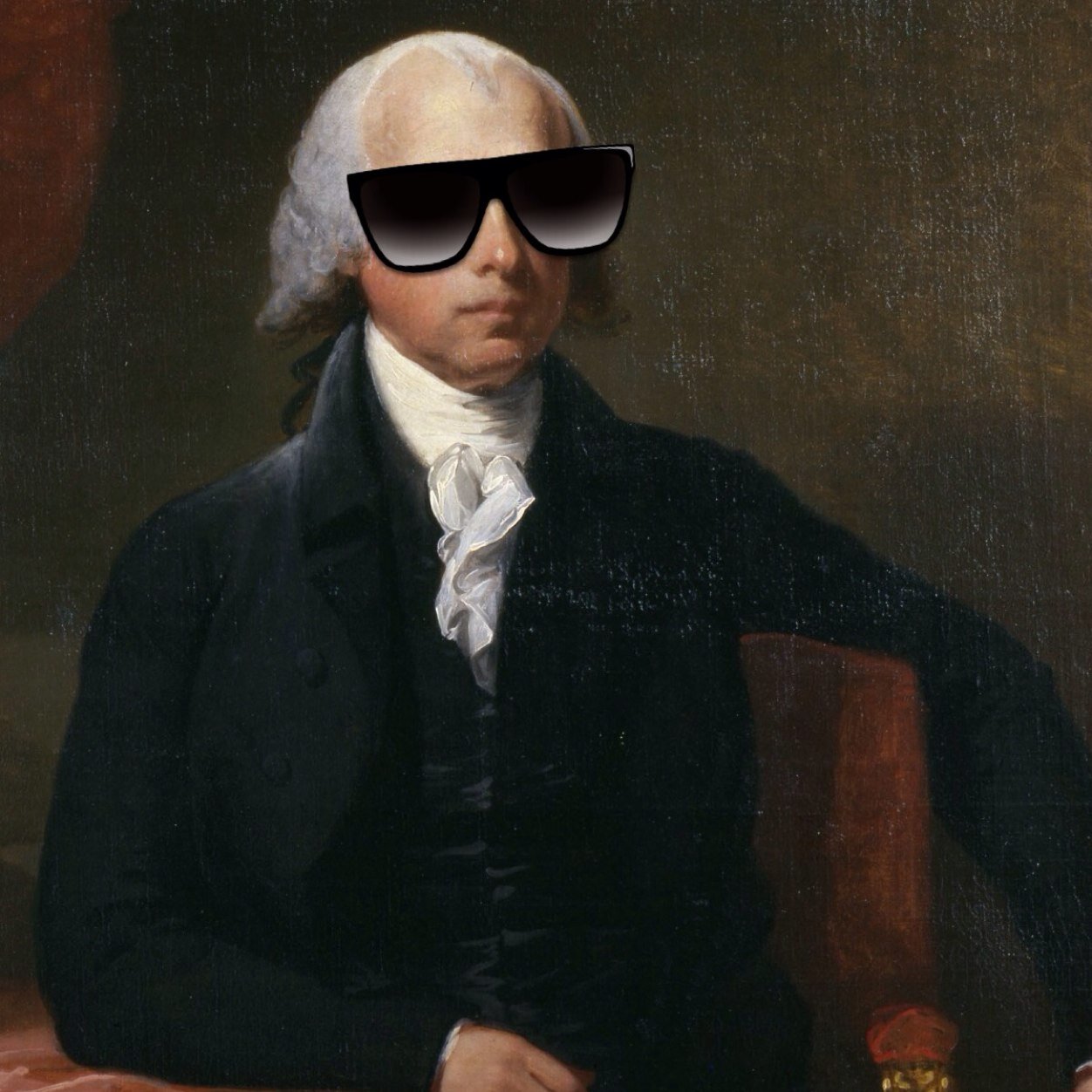
Thanks to Montesquieu's original idea and Madison's later elaboration in the federalist papers, we now have a government that is able to check each other's power. Portrait of James Madison c.

Colin Separation of Powers

Colin Baker
AP Gov
9/30/15
A major concern for the framers of the Constitution was political instability due to factions. In Federalist 10 James Madison describes factions as groups of people who gather together to protect and promote their special economic interests and political opinions. Factions are inevitable, for people will always have different economic situations, interests, backgrounds, and political views. Madison claims that there are two ways to control factions: eliminate the causes behind them or control the effects. To eliminate the causes behind factions, liberty of the citizens would have to be taken away which was most definitely not an option. If a single faction was to control the power in a government they would only seek to benefit themselves and the rights of the few would diminish. Madison argues that in a large republic with a representative government factional control is much harder to accomplish because political leaders have to try to appeal to so many people. Through the process of election outlined in the Constitution the voices of factions would be muted.
If powers in the government were not separated factional control would be easy to achieve for one group or person has the supreme power they would either tyrannically rule or the faction of the oppressed would unify and a civil war would be inevitable. The theory of separate powers and more specifically the tripartite system with a legislature, an executive, and a judiciary was originally described by the French Philosopher Montesquieu. Montesquieu argued that the best way to secure liberty and prevent a government from becoming corrupted was to divide the powers of government among different branches who would check each other. Factional control is simply not a possibility in this system for each branch is checked and balanced by the others. Relating to Madison’s argument, especially in the legislature there are so many elected representatives that the factions would be weakened. The representatives have a say in so many issues, factions are diminished for even if two people come from the same socio-economic situation, it is extremely unlikely that they agree upon every issue like abortion, education, gun control, immigration, etc. A separated representative government is a cure to blocking factional control.